Football Made Simple: How to Read Results, Understand Match Statistics and Spot the Weekend’s Biggest Talking Points
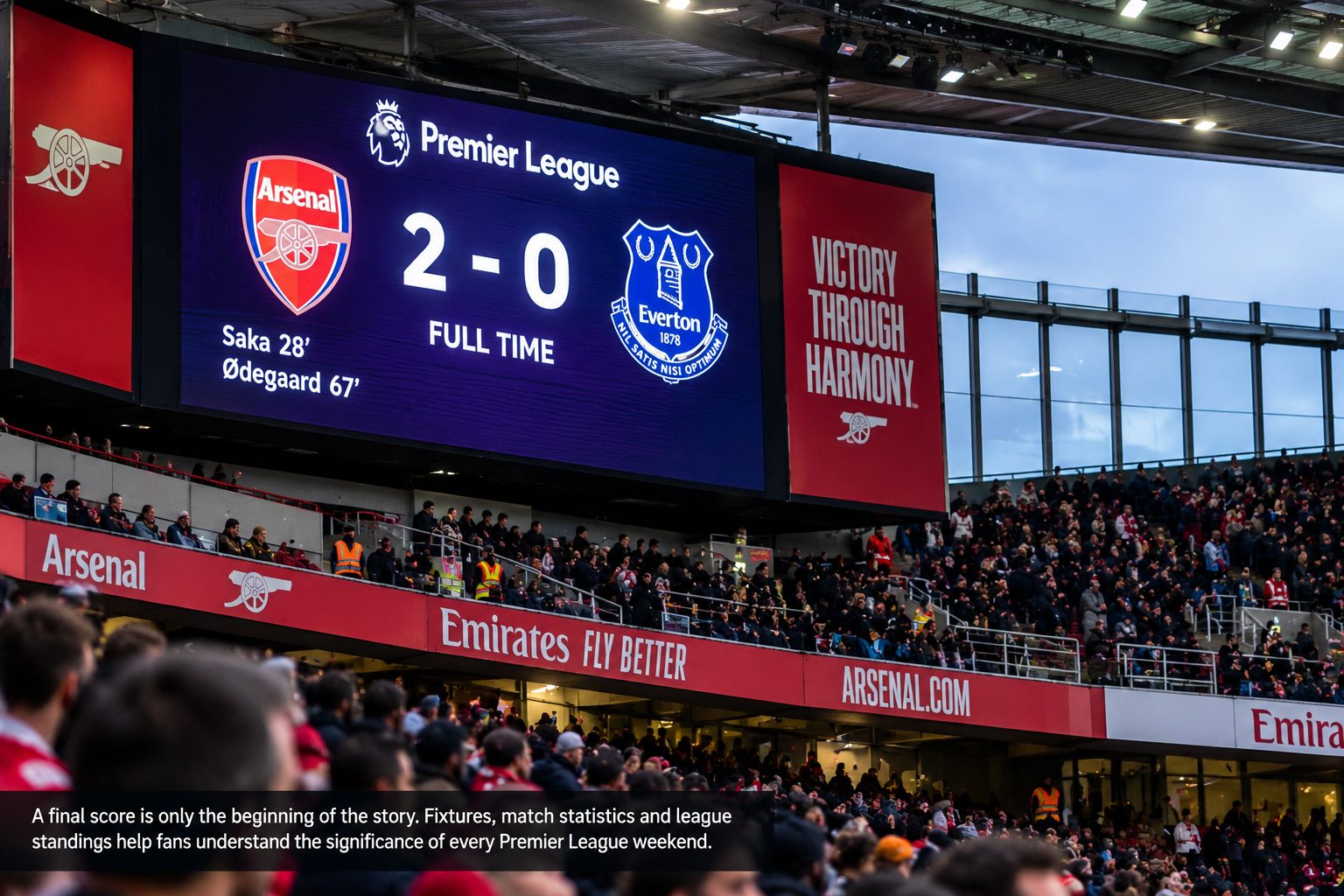
A busy Premier League weekend can produce dozens of conversations, dramatic scorelines and surprising results, but following the action does not have to be complicated. For casual fans, understanding a few basic football terms can make it easier to follow the league, join discussions with friends and recognise why a particular result matters.
The weekend of October 23–25, 2026, provided several good examples. Aston Villa defeated Manchester City 2–1, Arsenal beat Everton 2–0, and Bournemouth secured a convincing 3–0 away victory over Manchester United. Meanwhile, Liverpool defeated Brighton 2–0, while Sunderland and Leeds United played out a goalless draw. These results show why the final score is only the beginning of a football story.
Understanding Fixtures and Final Scores
The first step to following football is learning how to read a fixture. A fixture is simply a scheduled match between two teams. The team listed first is usually the home side, while the second is the away side.
For example, Aston Villa 2–1 Manchester City means Aston Villa scored two goals and Manchester City scored one. Because Villa scored more goals, they won the match. In contrast, a score of 1–1 means both teams scored once and the game ended in a draw.
Before kick-off, a fixture may display the teams, date, venue and start time. During the match, live score services update the score as goals are scored. Once the game ends, the result is marked as full-time, often abbreviated as FT.
It is also important to distinguish a fixture from a result. A fixture tells you what is scheduled to happen; a result tells you what actually happened.
The consequences extend beyond the 90 minutes. In the Premier League, a team receives three points for a win, one point for a draw and no points for a defeat. These points determine league positions throughout the season.
For instance, Aston Villa’s 2–1 victory over Manchester City earned Villa three points, while City left the match without any. A draw between Sunderland and Leeds, however, gave each team one point.
The Statistics That Matter After a Game
The scoreline tells fans who won, but statistics help explain how the match unfolded. Fortunately, beginners do not need to understand every number displayed on a football website.
- Possession Possession measures how much time a team controls the ball. A team with 65 per cent possession has controlled the ball for a larger share of the game than its opponent.
However, greater possession does not automatically mean a team played better. A side can dominate the ball without creating meaningful scoring opportunities, while its opponent may threaten repeatedly through quick counter-attacks.
- Shots and shots on target
The total number of shots shows how frequently a team attempted to score. Shots on target are attempts that would enter the goal if not stopped by the goalkeeper or a defender on the goal line.
A team that records many shots on target may have created more direct threats. Still, the quality of those opportunities matters. Ten weak efforts from distance may be less dangerous than three clear chances inside the penalty area.
- Expected goals (xG)
Expected goals, commonly written as xG, estimate the probability that a particular scoring opportunity will result in a goal. The calculation considers factors such as the location of the shot and the circumstances surrounding the attempt.
If a team records an xG of 2.0 but scores only once, it may have missed several good opportunities. If another team scores three goals from an xG of 0.8, its finishing may have been particularly effective, although a single match is not enough to establish a long-term pattern.
- Defensive statistics
Clean sheets, saves, tackles, interceptions and clearances can reveal how effectively a team defended. A clean sheet means a team conceded no goals.
Arsenal’s 2–0 victory over Everton, for example, combined two goals with a clean sheet. That makes the result more informative than simply saying Arsenal won: the team scored twice and prevented Everton from finding the net.
- Goal difference and league points
Goal difference is calculated by subtracting the total goals conceded from the total goals scored over a team’s league campaign.
A team that has scored 20 goals and conceded eight has a goal difference of +12. This figure can become important when teams finish level on points. League points remain the primary measure of progress, while goal difference helps separate teams with equal totals.
How to Spot the Real Talking Point
Not every match deserves the same headline. The challenge is to identify what made a result significant rather than merely repeating the final score.
Consider Aston Villa’s 2–1 victory over Manchester City. The immediate story is Villa’s win, but the larger talking point is that City suffered their first league defeat of the season. The result also brought Arsenal level with City on points, making the title race more competitive.
Manchester United’s 3–0 home defeat to Bournemouth provides another example. The scoreline is striking, but a useful report would ask why United lost, how Bournemouth created their opportunities and whether the result exposed weaknesses that could affect future matches. Those questions require match reports, statistics and, where available, comments from the managers and players.
A good football talking point usually falls into one of several categories: an unexpected result, an outstanding individual performance, a tactical decision, a costly mistake, a controversial refereeing decision or a result that significantly changes the league table.
Fans should also avoid drawing sweeping conclusions from a single game. One defeat does not automatically mean a team is in crisis, just as one impressive victory does not guarantee a successful season. Recent form, injuries, the quality of the opposition and the wider fixture schedule all provide useful context.
Following the Weekend Without Getting Lost
For casual supporters, a simple routine can make football easier to follow. Check the fixtures before the weekend, review the final scores afterwards, look at two or three key statistics and read a reliable match report about the most surprising result.
The official Premier League website provides fixtures, live scores, results, tables, match reports and other competition information. Checking the official results page also helps readers confirm scores before sharing them in conversations or publishing their own football commentary.
Ultimately, understanding football is not about memorising every statistic or knowing every player. It is about connecting the scoreline to the performance, recognising the significance of the result and asking the right questions.
The next time a friend celebrates a dramatic victory or complains about a disappointing defeat, the conversation can go beyond the numbers on the scoreboard. With a little attention to fixtures, statistics and context, any fan can begin to understand not only who won, but why the result matters.
Version 1.0. LDCP Network stories are edited before publication and updated as facts change. Spotted an error? Tell our editors.